

Home polysomnography · Type II sleep study
Level 2 Sleep Study at Home in Chennai
A Level 2 study records the same core signals as a hospital sleep test, brain waves included, while you sleep in your own bed. Nobody sits up watching; the recorder does the work and a sleep physician reads it afterwards. It costs less than a night in a lab and tells you far more than a basic home test.
What a Level 2 study actually is
Sleep tests are graded by how much they record and whether someone is watching. A Level 1 study is a full polysomnography in a lab, with a technician awake all night. A Level 3 home test records breathing, oxygen and pulse, enough to pick up obvious sleep apnea.
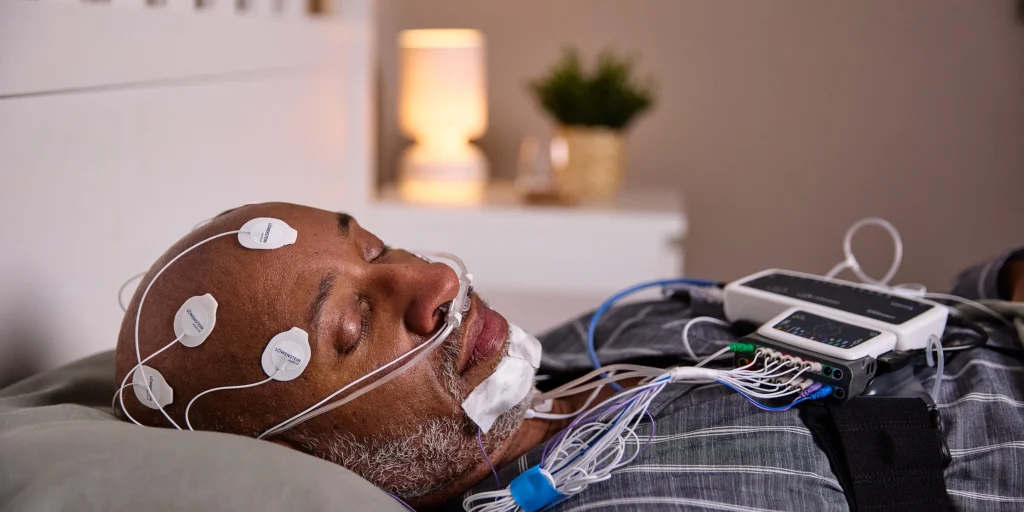
Level 2 sits between them. It is a full polysomnography with the brain, eye and muscle channels that let a scorer stage your sleep, but it is recorded without anyone watching, usually at home. The international definition asks for at least seven channels, including EEG, EOG, chin EMG, ECG or heart rate, airflow, breathing effort and oxygen saturation. Our Level 2 set on the Löwenstein Sonata records more than that minimum.
The practical difference is simple: a Level 3 device knows you were in bed; a Level 2 study knows whether you were asleep.
Why measuring sleep changes the result
Apnea severity is reported as the AHI: breathing events per hour of sleep. A basic home test cannot see sleep, so it divides by the hours it recorded instead. Most people do not sleep every minute they are in bed, and that gap matters more than you might expect.
A worked example
A man is in bed from 10:30 pm to 6:30 am, eight hours. He sleeps for five and a half of them; the rest is lying awake, checking his phone, a trip to the bathroom. During the night the recorder counts 100 breathing events.
Divided by time in bed
12.5 / hr
100 ÷ 8 hours: reads as mild
Divided by time asleep
18.2 / hr
100 ÷ 5.5 hours: reads as moderate
Same night, same events, a different category. There is a second effect too. Under the scoring rules most sleep labs use, a shallow-breathing episode (hypopnea) counts if oxygen drops by 3% or if it ends in a brief arousal from sleep. Only a study with EEG can see the arousal, so people whose oxygen holds up well, often younger and slimmer patients, can look healthier on a breathing-only test than they are.
How the AHI is graded in adults
- Under 5 per hourNormal
- 5 to 14 per hourMild
- 15 to 29 per hourModerate
- 30 or more per hourSevere
Your physician reads the number alongside your symptoms; it is not the only thing that decides treatment. Our guide to reading a sleep study report explains the rest of the page.
Level 1 vs Level 2 vs Level 3
What each study records with us, side by side.
| Level 1 · Lab PSG | Level 2 · Home PSG | Level 3 · Home test | |
|---|---|---|---|
| Where | Sleep lab | Your home | Your home |
| Technician watching all night | |||
| Brain waves (EEG): sleep stages and arousals | 6 channels | 2 channels | |
| Eye movement (EOG) and chin muscle (EMG) | |||
| Heart rhythm (ECG) | 3 channels | 3 channels | Heart rate |
| Airflow, breathing effort, oxygen | |||
| Leg movements | |||
| Price (before GST) | ₹16,500 | ₹13,500 | ₹8,000 |
Prices include the technician and delivery component. Full details for every level are on our sleep study in Chennai page.
Who a Level 2 study suits
A home test said "normal", but the symptoms have not gone away
Loud snoring, unrefreshing sleep, dozing off in meetings or at signals. A study that can see sleep and arousals often explains what a breathing-only test missed.
You suspect apnea and also sleep badly
If you lie awake for long stretches, a test that divides events by hours in bed will dilute the result. Level 2 divides by the hours you actually slept.
Getting to a lab is hard
Elderly parents, people recovering from illness, or anyone who simply cannot sleep in a hospital bed. The full study comes to them.
Your doctor wants sleep stages, not just breathing
Some people have most of their events in REM sleep or only on their back. Staging the night shows this, and it can change the advice you get.
When a lab night is the better choice
Level 2 is not the right test for everyone. A Level 1 study in a sleep lab is better if:
- Suspected narcolepsy or excessive sleepiness without snoring. The daytime nap test (MSLT) follows a night in the lab.
- Acting out dreams, sleepwalking, or jerking and thrashing in sleep. These need video and someone watching.
- Serious heart or lung disease, or you already use oxygen at night, where a technician should be present.
- Children. Sleep studies for children are normally done in a lab with a technician.
- You want CPAP pressure set the same night if severe apnea is found (a split-night study).
Your doctor decides which study you need. If you tell us your symptoms, we will say plainly if we think a different level suits you better.
How the night goes
- 1
On the day
Avoid an afternoon nap and skip tea or coffee after about 2 pm. Wash your hair and leave it dry, with no oil: the scalp sensors stick far better to clean hair. Take your usual medicines unless your doctor has told you otherwise.
- 2
Evening set-up
Our technician brings the Sonata recorder and fits the sensors: small electrodes on the scalp, beside the eyes and on the chin, ECG patches on the chest, two soft belts round the chest and tummy, a thin nasal tube for airflow and a finger clip for oxygen. Wear a loose two-piece night suit.
- 3
The night
Go to bed at your normal time. You can turn over and get up to use the bathroom; the recorder is small and travels with you. Keep a note of roughly when you went to bed, woke in the night and got up. It helps the scorer.
- 4
Next morning
The sensors peel off; warm water removes any paste left in the hair. The recorder is collected and the data goes to scoring. Your report follows, and if treatment is needed we explain the options.
More detail in how to prepare for a sleep study and what each sensor measures.
What your report will show
Because the night is staged, the report goes well beyond a single apnea number. These are the figures your doctor will look at first.
- AHI
- Breathing events per hour of sleep. The headline number for apnea severity.
- Sleep efficiency
- How much of your time in bed was actually spent asleep.
- Sleep stages
- Time in light, deep and REM sleep, and how often sleep was broken.
- Arousal index
- Brief awakenings per hour, which you will not remember but which leave you tired.
- REM and supine AHI
- Whether the problem is worse in dream sleep or lying on your back.
- Lowest oxygen and time below 90%
- How far and how long oxygen fell during the night.
Book a Level 2 study, or ask if it is the right one
Leave your name and number. We will call you back, ask about your symptoms and any earlier test, suggest the level that fits, and fix a night that suits you anywhere in Chennai.
Not sure yet? Compare all sleep study levels and prices, read about the sleep apnea test, or see how the CPAP titration study sets your pressure after diagnosis.