
How a Sleep Study Test Works: Explained Through a Real Sonata Study
A one-minute Sonata sleep study video, slowed down: every sensor that goes on, what it measures, how the night is scored, and what your report shows.
The video below is just over a minute long. It shows one sleep study on the Löwenstein Sonata, from the moment the technician sits down with the patient to the moment the family walks out of the clinic the next morning. There is a lot packed into that minute, and most of it goes past too quickly to make sense of if you have never seen a sleep study before. So this article slows it down. We go through what is happening in each scene, what every sensor on the body is measuring, and what the sleep physician actually does with the recording afterwards.
If you only want prices and slots, the sleep study test in Chennai page has them. If you want to understand the test before you agree to it, read on.
What happens in the video, scene by scene
0:00 to 0:09 · The technician explains the night before anything is attached
The first thing you see is not a wire. It is the technician sitting with the patient, a young child in this video with a parent nearby, and talking them through the night. This part matters more than people think. A sleep study only works if you actually sleep, and people sleep badly when they are anxious about what is stuck to them. A good technician will show you each sensor in their hand before it goes on and tell you which ones you might feel.
Then the patient sits up and two soft belts go around the body, one around the chest and one around the abdomen. These are the respiratory effort belts. We come back to why there are two of them further down, because that detail is how the doctor tells one type of sleep apnea from another.
0:13 · The Sonata recorder and its leads
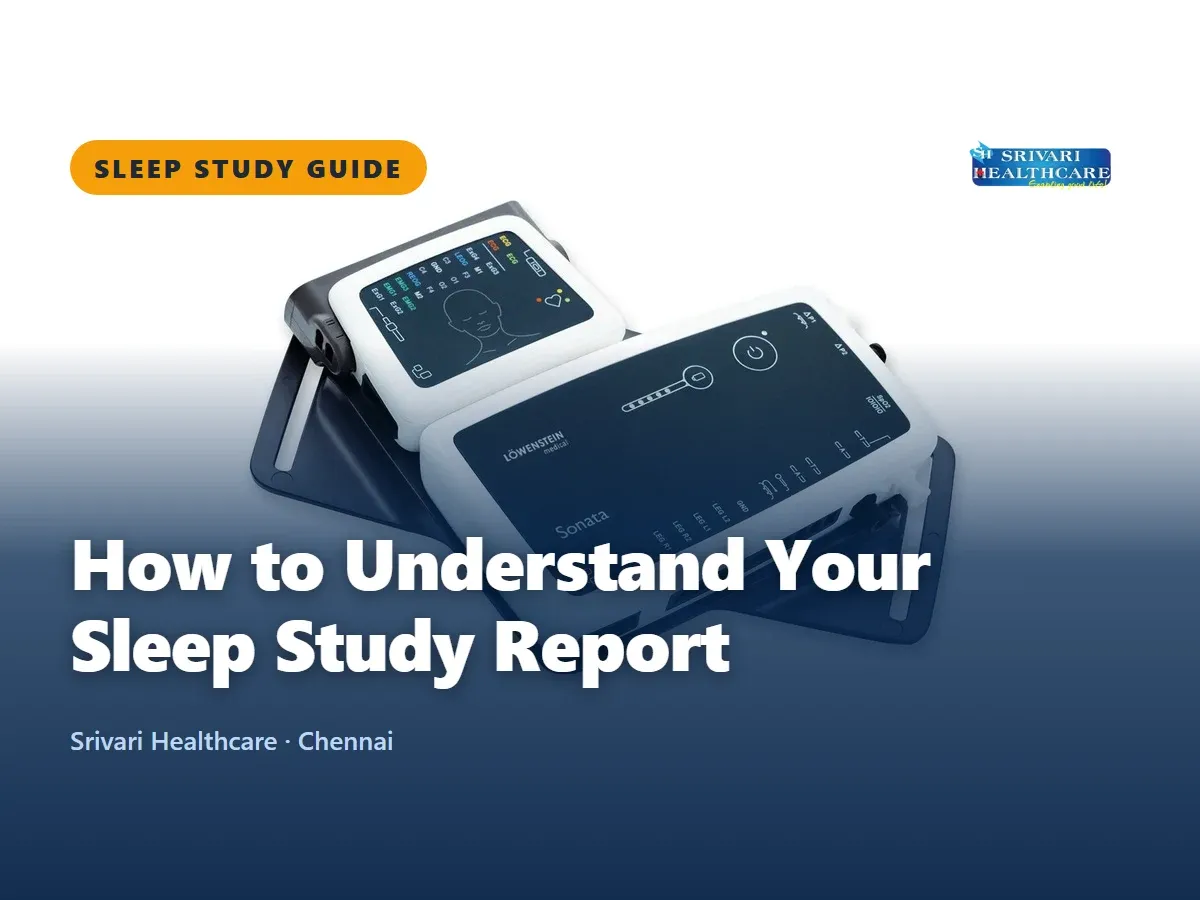
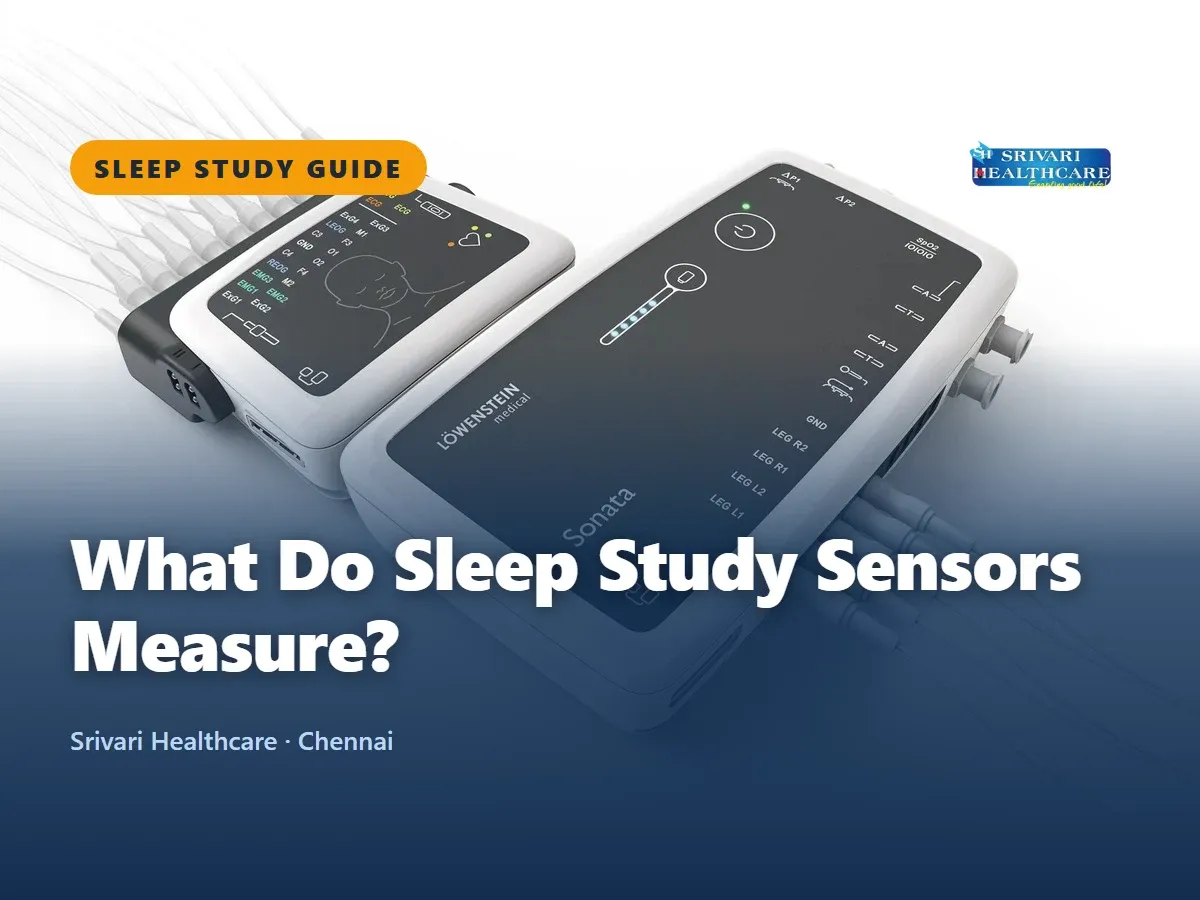
At 0:13 you see the Sonata itself: a small recorder with a row of ports, and the technician plugging lead wires into it one by one. Every sensor on the body ends in a lead, and every lead goes into this box. The recorder is worn on the body, so the patient is not tied to a machine on the wall and can turn over in bed normally.
0:17 to 0:25 · Chin, face and the nasal cannula
Next come the small electrodes on the chin and face. The ones under the chin pick up muscle tone. The ones beside the eyes pick up eye movement. You also see a thin plastic tube placed just inside the nostrils and looped over the ears. That is the nasal cannula, and it measures the air going in and out of your nose with every breath. It looks like the oxygen tube you see in hospitals, but nothing flows through it into you. It only senses pressure.
0:29 · The head net
At 0:29 a stretchy net goes over the head. Under it are the EEG electrodes, the ones that record brain activity. The net is simply there to hold them in place, so they do not slide when the patient turns their head on the pillow at two in the morning. This is the part people tend to worry about, and it is also the part they forget about once the lights are off.
0:33 to 0:45 · The night
The patient is now in bed in the sleep room. Cut to the technician in another room, sitting in front of a computer with the live signals scrolling across the screen. This is what makes a Level 1 study "attended": someone is awake and watching the whole night. If a lead comes loose, or the finger probe slips off, they see a flat line on screen and walk in to fix it. In the video you see the technician come in and check on the patient while they sleep. Most patients do not remember this happening.
0:49 · Reading the recording
A clinician is looking at the data on large screens. This is the scoring, and it is the slowest and most skilled part of the whole process. We explain what they are looking for in its own section below.
0:53 to 0:57 · Going home
Morning. The sensors come off, the patient and parent leave the clinic. There is no recovery time. Nothing was injected or swallowed, and you can go straight to school or work.
What each sensor is actually measuring
The video shows where things go. It does not say why. Here is everything the Sonata records in a complete study, and what each signal tells the doctor.
- EEG (brain activity) from the electrodes under the head net. This is what shows whether you are awake, in light sleep, deep sleep or REM (dream) sleep, and it catches the brief arousals where the brain half-wakes for a few seconds.
- EOG (eye movement) from the electrodes beside the eyes. The quick darting eye movements of REM sleep show up here.
- Chin EMG from under the chin. Muscle tone normally drops in REM sleep. If it does not, and the person moves or acts out dreams, that points to REM sleep behaviour disorder.
- Leg EMG from sensors on both shins, for the repeated leg jerks of periodic limb movement.
- ECG on the chest: heart rate and rhythm, including the slowing and speeding up that often goes along with breathing pauses.
- Airflow through the nasal cannula, with a sensor near the mouth for people who breathe through the mouth. It shows whether air is moving normally, reduced, or stopped.
- Chest and abdomen belts, which show whether the body is trying to breathe.
- Pulse oximeter on a fingertip for blood oxygen (SpO₂), and how far it falls with each event.
- Snore microphone and body position sensor, so the report can show how much you snore and whether your breathing is worse when you lie on your back.
The two belts deserve a word. When breathing stops in obstructive sleep apnea, the throat has collapsed but the body keeps trying: the belts show the chest and abdomen still moving, often in opposite directions, while the cannula shows no air. In central sleep apnea the brain simply stops sending the signal to breathe, so the belts go flat along with the airflow. Same pause on the airflow line, two completely different problems, and they are treated differently. Without effort belts you cannot tell them apart.
How the recording becomes a report
One night gives roughly seven or eight hours of all those signals running side by side. The scorer works through it in 30-second pages, called epochs, and does two jobs.
First, sleep staging. Each epoch is marked as wake, N1, N2, N3 (deep sleep) or REM, mainly from the EEG, EOG and chin EMG. This gives the actual time you were asleep, which can be quite different from the time you were in bed.
Second, event scoring. Following the AASM scoring manual:
- An apnea is a drop in airflow of 90% or more lasting at least 10 seconds.
- A hypopnea is a drop of 30% or more for at least 10 seconds that comes with an oxygen fall of 3% or more, or with an arousal on the EEG.
Count the apneas and hypopneas, divide by the hours of sleep, and you get the AHI (apnea-hypopnea index). In adults, under 5 is normal, 5 to 15 is mild, 15 to 30 is moderate and 30 or more is severe. The report also shows the lowest oxygen level of the night, how long you spent below 90%, whether the events were worse on your back or in REM, the heart rhythm, and limb movements.
Sleep study and CPAP therapy in Chennai
Home sleep test with Scala / SAMOA, Sonata polysomnography in our sleep lab — and the CPAP or BiPAP therapy that follows.
The sleep physician then reads all of that against your symptoms. Two people with an AHI of 20 can need different advice if one of them dropped to 75% oxygen and the other never went below 88%. Our reports usually reach you within 24 to 48 hours of the study.
Is a home sleep test the same thing?
Not quite, and it is worth knowing the difference before you choose.
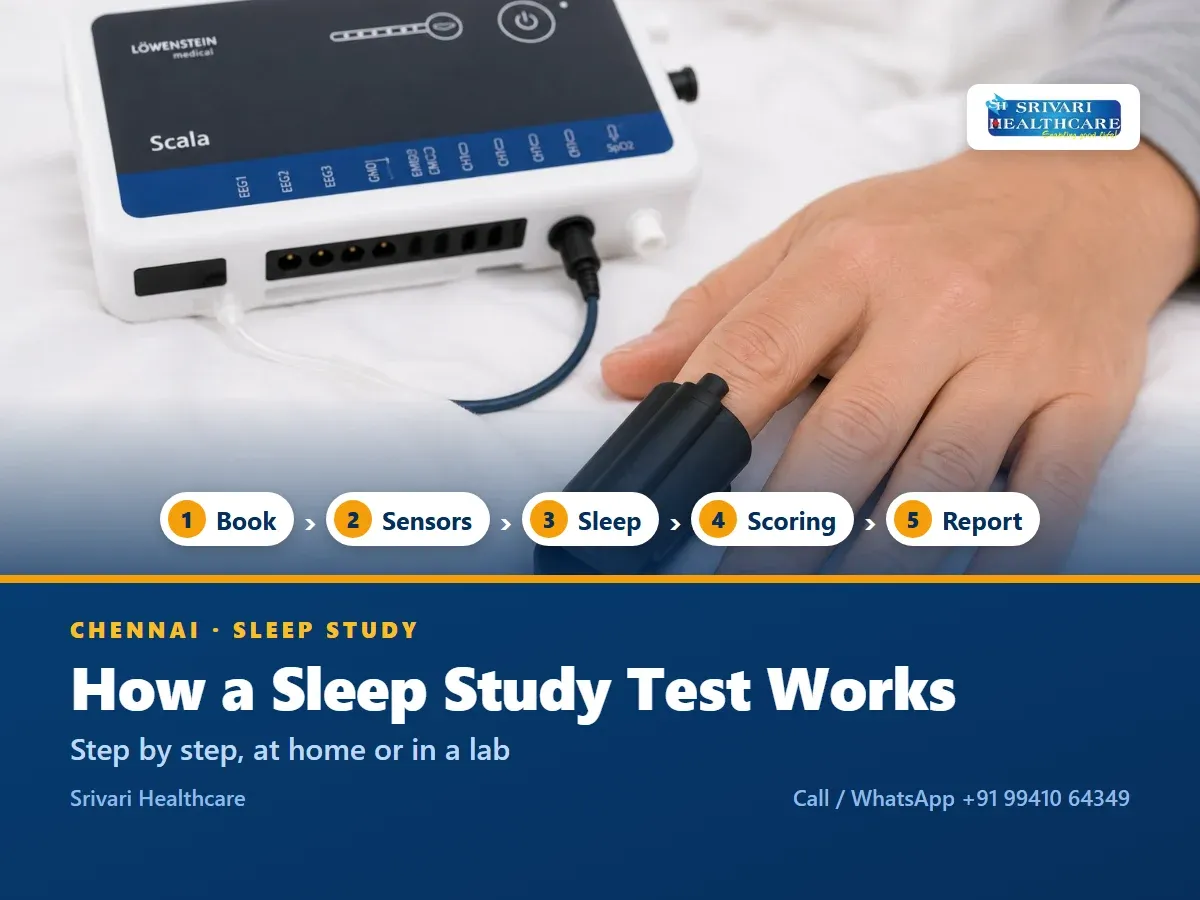
The video shows a full Level 1 study in a sleep lab. A Level 2 study uses the same Sonata and records EEG too, but it is done in your own bed. Our technician fits the sensors at home and nobody watches overnight. A Level 3 home sleep test, which we do on the Löwenstein Scala, is much simpler: belts, a finger oximeter and a nasal cannula. No head net, no face electrodes.
That simplicity is the point of Level 3. It is easy to wear, and it is very good at answering one question: does this person have obstructive sleep apnea, and how bad is it? What it cannot do is see sleep itself. With no EEG, it does not know when you actually fell asleep, so events are counted against the recording time instead of the sleep time. In someone who lay awake for two hours, that can make the result look milder than it is. It also cannot look for narcolepsy, REM behaviour disorder, seizures in sleep or limb movement problems.
So the rough rule we follow with referring doctors: snoring with daytime sleepiness and suspected obstructive apnea, a home test is usually enough. Anything more complicated, or a home result that does not match how unwell the person feels, needs the full study.
Prices, all before GST, including the technician and delivery component: Level 3 home test ₹8,000, Level 2 home PSG ₹13,500, Level 1 lab PSG ₹16,500. The full breakdown is in the sleep study price table, and the home options are explained on the home sleep study in Chennai page.
Before your study night
Things patients ask us about, or that we wish they had known:
- Wash your hair that day and do not put oil in it. Hair oil is one of the commonest reasons a scalp electrode gives a noisy signal. Dry, clean hair holds the electrodes better.
- Wear something loose and cotton, with buttons or a wide neck, so the belts and leads can go on without fuss.
- Keep coffee and tea to the morning, and try not to nap in the afternoon. You want to be properly sleepy at bedtime.
- Take your usual medicines unless your doctor has told you otherwise, and tell the technician what you take, including sleeping tablets.
- Remove nail polish from at least one finger. Dark polish can upset the oximeter reading.
- Go to bed at your normal time. Nobody expects a perfect night. A few hours of sleep is usually enough for a useful recording.
If you want a calmer, more personal account of the night itself, how the sensors feel and what it is like to fall asleep with them, read what happens during an overnight sleep study.
After the report
If the study confirms sleep apnea and your doctor prescribes therapy, the usual next step is CPAP, or BiPAP for people who need two different pressures. The pressure has to be right for you, and that is what a titration study is for: another night with a recorder on, while the pressure is adjusted and the mask fit is checked. It costs ₹3,000 + GST with us. For a step-by-step look at testing specifically for apnea, see the sleep apnea test in Chennai page.
Booking
Tell us the symptoms and whether a doctor has already suggested a level, and we will tell you which study fits and when we can do it. Call or WhatsApp +91 99410 64349 (call · WhatsApp), or book on the sleep study page.
Frequently Asked Questions
Does a sleep study hurt?
No. Nothing goes through the skin. The electrodes sit on the surface with paste or tape, the belts are soft, and the cannula rests just inside the nostrils. Most people find the head net the strangest part, and stop noticing it once they are asleep.
How long does it take to put all the sensors on?
For a full study with EEG, set-up usually takes the better part of an hour, because each electrode has to be placed and checked for a clean signal. A Level 3 home test with just belts, oximeter and cannula takes a few minutes.
What if a sensor comes off during the night?
In an attended lab study, the technician sees it on screen and comes in to fix it, as in the video. In a home study the recording simply has a gap. If enough of the night is still clean, it can be scored. If not, the study is repeated.
Can children have a sleep study?
Yes. The patient in the video is a child, and the set-up is the same. Children are scored with paediatric rules, which are stricter than the adult ones, so the report has to be read by someone used to children's studies. Ask us before booking for a child.
What is the difference between AHI and oxygen drops in the report?
AHI counts how many times per hour breathing stopped or became very shallow. The oxygen figures show how much those events affected your blood oxygen. The sleep physician looks at both, because the same AHI can be more or less serious depending on how far oxygen falls.
This article explains how the test is done. It does not replace advice from your own doctor about your symptoms or results.
Buy or rent in Chennai
Sleep study test in Chennai
Free home delivery, installation by a respiratory therapist and 24/7 support. Authorized Löwenstein Medical dealer.
- DeviceHome sleep study equipment — ScalaView page
- LabSonata polysomnographyView page
- Buyprisma SMART auto CPAPView page
Home sleep study in ChennaiSleep apnea test in ChennaiSleep lab ChennaiSleep study equipmentAll sleep diagnosticsRental enquiryAsk for a quoteAll products