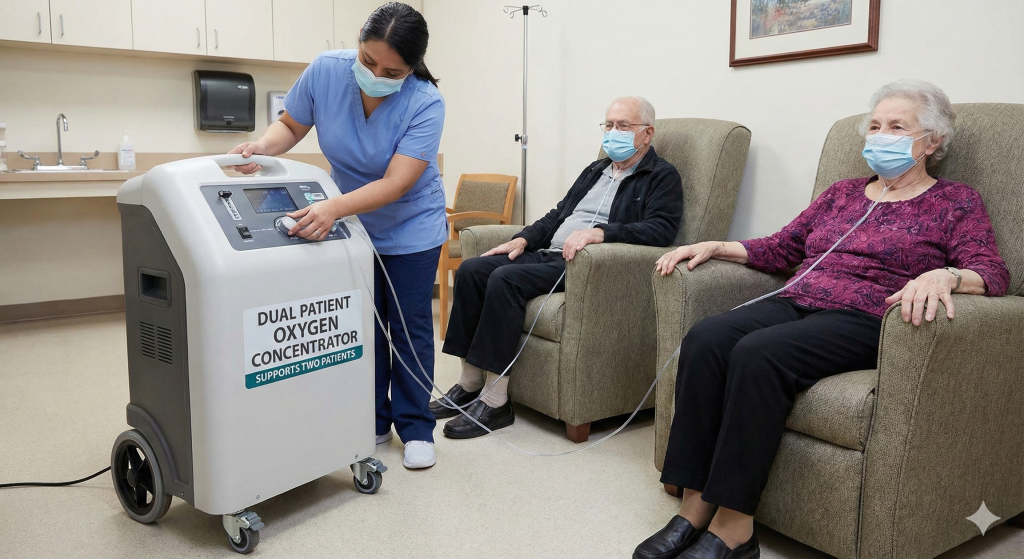
Dual Patient Oxygen Concentrator

In critical care environments, time and resources are everything. The Dual Patient oxygen concentrator is a breakthrough innovation that allows healthcare providers to deliver high-purity oxygen to two patients at once, without compromising on flow rate or quality. This powerful device is especially valuable in ICUs, emergency wards, and field hospitals, where demand for oxygen therapy is high and rapid response is crucial. For households, clinics, or care facilities managing the needs of multiple individuals requiring supplemental oxygen therapy, a single-device solution offers significant advantages. The Dual Patient Oxygen Concentrator—an innovative medical device engineered to support two patients simultaneously from a single unit. This groundbreaking technology is not just about convenience; it represents a cost-effective, space-saving, and highly practical way to deliver essential life support.

Understanding the Power of Dual-Capacity Oxygen Delivery

Traditional oxygen concentrators are designed to serve one patient. The dual patient model leverages the same core technology—Pressure Swing Adsorption (PSA)—but with an enhanced design to manage a higher flow rate and distribute the concentrated oxygen effectively between two separate users.

How It Works: Oxygen Concentration for Two Like a standard concentrator, the dual unit draws in ambient air, which is roughly 21% oxygen.

Inside the machine:

Compression: An air compressor pressurizes the air.
Filtration: The air is forced through sieve beds filled with zeolite material.
Nitrogen Separation: The zeolite selectively adsorbs (traps) nitrogen molecules under high pressure, allowing the concentrated oxygen (typically 90-95% pure) to pass through.
Dual Outlet System: The purified oxygen is then channeled into a dual-outlet or flow-splitter system. Each outlet is typically equipped with its own flow meter and regulator, allowing clinicians or caregivers to set and monitor the precise, individualized flow rate (measured in Liters Per Minute or LPM) prescribed for each patient.

This ability to independently regulate the oxygen delivery ensures that both individuals receive their specific therapeutic dosage without compromise, all from one powerful machine.

Key Features and Benefits

Here’s why healthcare providers and caregivers are turning to dual flow oxygen concentrators:

Dual Flow Outlets: Two separate oxygen ports allow independent flow control for each patient, typically ranging from 0.5 to 5 or 10 liters per minute (LPM) per outlet.
High Oxygen Purity: Delivers medical-grade oxygen with purity levels of 90% or higher, even at higher flow rates.
Cost-Effective: One machine serves two patients, reducing equipment costs and saving space.
Portable and User-Friendly: Many models come with wheels, handles, and remote controls for easy mobility and operation

Ideal Use Cases

Dual patient oxygen concentrators are particularly beneficial in:

Hospitals and ICUs: Where multiple patients may need oxygen therapy simultaneously.
Home Care: For households with two patients requiring long-term oxygen therapy.
Rural Clinics: Where resources are limited and maximizing equipment utility is essential.
Emergency Response Units: During outbreaks like COVID-19, where rapid deployment of oxygen support is critical

Reliability and Peace of Mind

High-quality dual concentrators are built for sustained, continuous operation.
Having a single, reliable unit that is often designed with commercial or hospital-grade durability can offer enhanced peace of mind.
Furthermore, some models may feature robust internal components to ensure that the required oxygen purity and flow are maintained for both patients, even under heavy usage.

Ideal Scenarios for Dual Patient Concentrators

This type of concentrator is an excellent fit for several environments:

Home Care: For couples or family members in the same household who both require continuous or intermittent oxygen therapy (e.g., for COPD, pulmonary fibrosis, or sleep apnea).
Small Clinics & Nursing Homes: Where a limited number of patients need oxygen and centralized wall oxygen is unavailable or impractical.
Disaster Relief/Field Hospitals: In resource-constrained settings, a dual-outlet machine can maximize the utility of available medical equipment.
Shopping Cart
Scroll to Top